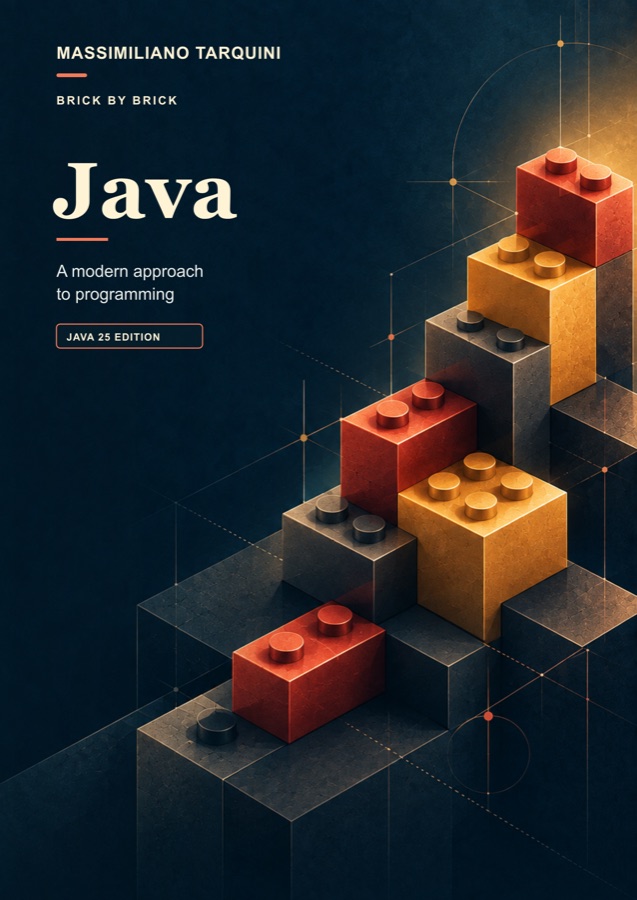
Programming · Java 25 · Draft
Java Brick by Brick
A modern approach to programming
Start with concepts, build a mental model and learn to choose the right solution. A journey through Java programming, one brick at a time.
Explore the contents ↓The next step: reading.
Download the complete English translation of the Java 25 draft · 402 pages. Editorial review remains open.
PDF · 7.5 MB · English
Download the book ↓You may share and adapt the book for non-commercial purposes, crediting the authors, linking to the licence and identifying changes. See the full licence terms.
THE READING JOURNEY
Table of contents
The journey starts with Java concepts and tools, moves on to building programs, and reaches concurrency, resources and quality. The contents follow the current Java 25 draft; the groups below help you navigate the reading.
Foundations and objects
From the introduction to types, objects and error handling.
- 1. Preface
- 2. Object-Oriented Programming
- 3. The Java Language and the Tools for Using It
- 4. Syntax, Variables, Operators, and Arrays
- 5. Controlling Program Flow
- 6. Packages and Modules
- 7. Defining classes and objects
- 8. Encapsulation
- 9. Inheritance, composition and sealed hierarchies
- 10. Object, wrapper classes and enumerations
- 11. Strings and Unicode text
- 12. Exceptions and error handling
Types, functions and data
Interfaces, annotations, generics and tools for processing collections of data.
- 13. Interfaces, abstract classes and polymorphism
- 14. Annotations: metadata and checks
- 15. Generics and Type Checking
- 16. Functions and Lambdas in Java
- 17. Choosing a Collection
- 18. Stream API: Pipelines, Reductions and Gatherers
- 19. Optional: When a Search Finds Nothing
Concurrency and platform tools
From concurrent work to interaction with files, networks and native functions.
- 20. Threads and Concurrency in Java
- 20A. Atomic Operations: One Shared Decision at a Time
- 21. Java Classloaders: Finding a Class While the Program Runs
- 23. Further reading: Vector API, processing data in groups
- 24. Reflection API: observing types at runtime
- 25. I/O, files and resources: taking data beyond the program
- 26. Time, localization and exact numbers
- 27. Networking and HTTP: asking another process for data
- 28. External memory and native functions: crossing the JVM boundary
Distribution, quality and exercises
Prepare a program for others, check its behaviour and put your learning to the test.
- 29. From source to a program someone else can run
- 30. Quality, security and observability: understanding when the program is not enough
- Activities and Reasoned Solutions C01–C06
- Phase 3 activities
- C13–C18 Activities, First Draft
- C19–C24 activities, first draft
- C20A Activities — Atomic Operations
- Concluding activities: choosing the next brick
- C25–C28 activities: choose, test, transfer
- Guided activities for C29 and C30
- Conclusions. Keep building, brick by brick
BEFORE YOU START
A question to start with.
How do we move from knowing syntax to reasoning about a program?
The book builds the tools to address this question and recognise the limits of the answers.